
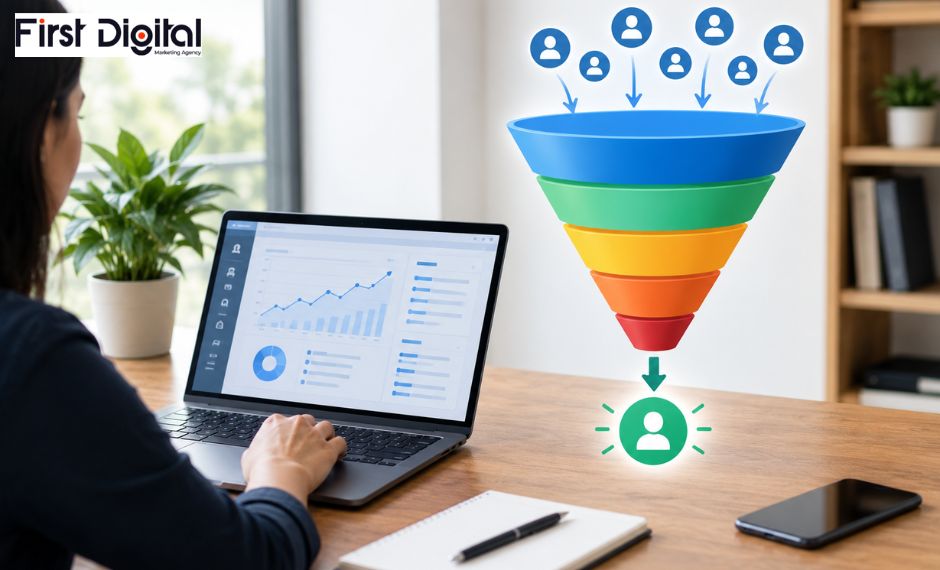
Turning website visitors into paying customers does not happen by chance. Rather, it is always a thought-out process aimed at attracting attention, building trust, and leading prospects to act. This process is known as a digital marketing funnel. Without a well-structured funnel, even a website with steady traffic can struggle to generate meaningful results. After viewing a couple of pages, people may decide not to do anything further. An effective funnel, however, makes sure that you attract the right kind of audience, generate their interest, nurture the leads with relevant information, and help prospects to become customers through a clear and engaging journey that encourages informed decision-making at every stage.
Building a digital marketing funnel is not just about increasing website traffic. Instead, what it requires is creating the right experiences at every step of the customer journey and delivering the right message at the right time. In this blog, we will talk about the key steps of an effective digital marketing funnel, strategies for optimizing each step of the way, and mistakes you need to avoid to improve conversions and build stronger, long-term customer relationships.
What Is a Digital Marketing Funnel?
A digital marketing funnel is the process through which a prospect (visiting your website or business) moves from initial awareness to paying customer. It is called a funnel because, typically a high number of prospects will enter at the top of the funnel, and as they move down the funnel, the prospects will narrow down until finally there are paying customers at the bottom of the funnel.
The Four Stages of a Funnel
Most funnels have four stages – awareness, interest, decision and action. The fifth stage, retention, is a process that encourages repeat purchases from existing customers. Why you need a funnel for your business? If you don’t have a funnel, your marketing efforts are random, that is, like burning out money into thin air.
With a funnel, everything has a purpose — and if something is not working, you will see it. For small businesses, it is about squeezing every drop of value out of their marketing budgets. For bigger businesses, a funnel helps multiple teams and channels with a unified purpose.
1. Awareness – How to Get Found by the Right Prospects
At the first stage, prospects are unaware of you and your business. Some may not yet realize that they need a product or service like yours. How to introduce yourself or establish your presence?
- SEO: Blogs, articles, and optimized web pages help customers find you when they search for a solution to their needs.
- Google Business Profile: This is particularly vital if you have a physical storefront. This is probably the first ‘search result’ that your prospects see when searching for businesses like yours in your area.
- Social Media: Here you can engage your prospects with short videos, posts, and stories. Most businesses in calicut outsource their social media marketing to a social media marketing agency in calicut, who manage their social media content creation and engagement with the local audience.
- Google and Meta (Facebook) Ads: These are excellent for targeting the exact needs of your prospects. You should work with a digital marketing agency in Calicut to ensure your Google and Meta ads are targeting the best keywords and audiences.
2. Interest – Give People a Reason to Stay
After getting the prospects’ attention, you must ensure they choose your business over your competitors. Here, you entice your prospects with something valuable. In other words, you give them a sample of what you can offer them if they provide you with their contact details. Examples of freebies: Lead magnets (free guides, checklists, video series), WhatsApp list (a weekly or monthly WhatsApp update), etc. This is the most important step since it is the point at which your prospects have ‘expressed interest’ in your business. You can now follow up with targeted emails or WhatsApp messages.
3. Decision – How to Encourage Prospects to Make a Purchase
At this stage, your prospect is considering your business. Essentially, they’re asking themselves: “Is this trustworthy?” We can convince prospects with:
- Customer reviews and testimonials
- Case studies of businesses similar to your prospect’s business
- Information about your services and processes
- Quick responses to WhatsApp, phone calls, and emails
4. Action – How to Encourage Prospects to Actually Buy
This is the shortest step in the funnel, and it is the step where most businesses fail — they do not make it easy for the prospect to take action. You must give your prospects one prominent call-to-action button or link. Some things to remember –
- Avoid landing pages with long lead capture forms — the more fields you have to fill, the less likely they will be to submit the form
- Make sure your website is mobile-friendly and loads fast
- Use retargeting ads (ads that target people who have visited your website but have not taken any action)
5. Retention – How to Encourage Repeat Sales
After converting the prospect to a customer, you need to make sure they are 100% satisfied with your services. You should also remind them to leave a review of your business online (ideally on Google Business Profile). You can also incentivize them to do more business with you (offer a discount, give special offer) or reward them for referring friends to your business.
How to Know If Your Funnel Is Working?
Here are some benchmarks that will tell you if each stage is working:
- Awareness: Number of website visits, reach, and impressions
- Interest: Number of sign-ups and downloads
- Decision: Number of enquiries and calls
- Action: Number of sales and conversion rate
- Retention: Number of repeat sales
Google Analytics and Ads Manager will tell you most of these metrics. You can then check them out every month and take action where necessary. If your website has lots of visits but few enquiries, for example, you need to work on the next steps in your funnel.
Funnels – For Small and Large Businesses
Whether you’re managing your business single-handedly or you have a team of ten, the basic funnel is the same, but how you execute it will depend on your resources. Here’s how to start:
For small businesses: Set up and optimize your Google Business Profile, start engaging posts on your social media profiles, set up a landing page, and a WhatsApp auto responder. You can build upon this as you grow.
For bigger businesses: These typically require separate funnels for your different products and target markets, a customer relationship management (CRM) platform to capture and organize your leads, and an ongoing A/B test process (for your ads and landing pages).
Common Pitfalls to Avoid
- Only focusing on the first step (awareness), and not the subsequent stages
- Ignoring mobile traffic, most website visits come from mobile users
- Not following up with leads quickly enough
- Expecting immediate results
Better Strategies, Better Result
A digital marketing funnel is not as complicated as it sounds. Once you understand how it works, you can start to optimize your digital marketing to convert more website visits into sales.
You should start by reviewing your digital marketing process and analyze where your website visitors are getting ‘stuck’. You can also contact the experts at First Digital, a digital marketing agency in Calicut, to assist you with every step of your digital marketing funnel — from SEO and Google Ads to Meta campaign management, and WhatsApp marketing. First Digital also offers monthly performance reporting to let you know what is working and what isn’t. Ready to convert more website visitors into customers? Contact First Digital today for a free discovery call.


